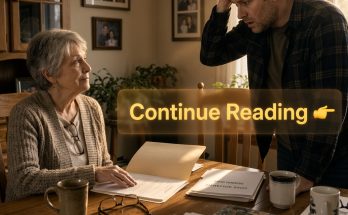
His lips moved silently before he finally said the words aloud.
“Should the advancement equal or exceed the beneficiary’s eventual share, no additional distribution shall be due to that beneficiary.”
The room became completely silent.
Kyle stared at the page.
Then he laughed.
Not because anything was funny.
It was that nervous, uncomfortable laugh people make when reality has just become something they desperately wish they could escape.
“Mom, you’re telling me I might not get anything else?”
“I’m telling you that you received part of your inheritance early, exactly as you requested.”
“But I’m your only son!”
“That doesn’t change what you signed.”
He dropped the document onto the coffee table.
“Who put this in here?”
“Your father and I discussed this arrangement years ago. Mr. Dunne updated the paperwork after your request in March.”
“Why didn’t you tell me?”
I looked at him.
“I did. Mr. Dunne read every word aloud. You were sitting right there. You signed three separate times.”
Kyle rubbed his forehead.
“That lawyer tricked me.”
I almost smiled.
“No, honey. Mr. Dunne explained it to you. You were too busy calculating what you could buy with the money.”
His face hardened.
“Well, that doesn’t matter. The house is still mine eventually.”
I leaned back.
“Actually, Kyle, that’s where you’re mistaken.”
He looked up.
“What?”
I pointed toward the document.
“Keep turning the pages.”
He hesitated.
Then he turned to the second page.
There was another section, this one concerning the house.
I watched him read the first few lines.
His eyebrows pulled together.
Then his eyes widened.
“Mom…”
“Yes?”
“Why does this say the house isn’t included in the inheritance distribution?”
“Because your father and I made certain arrangements.”
He shook his head.
“No. No, that doesn’t make sense. Dad left you everything.”
“He did.”
“So eventually it comes to me!”
“Not necessarily.”
I stood up slowly and walked toward the fireplace.
Above it was a photograph of Frank and me standing beside our first tractor, taken nearly forty years earlier.
We looked younger, thinner, and considerably more hopeful about the future.
Frank had his arm around my shoulders.
I remembered that afternoon clearly.
We had just finished paying off the mortgage on the farmhouse.
We had celebrated with two cheap hamburgers and a bottle of sparkling cider.
Frank had kissed my forehead and said, “Now nobody can tell us what to do with this place.”
He had meant it.
And I had spent the rest of our marriage making sure those words remained true.
“Kyle,” I said, turning back toward him, “your father worked for forty-six years to build what we have. He knew you loved us, but he also knew you weren’t particularly careful with money.”
“That’s not fair.”
“Maybe not. But it was his concern.”
“My father loved me.”
“He did. Very much.”
“Then why would he do this?”
“Because loving someone doesn’t mean handing them everything they demand.”
Kyle looked down again.
The document contained a provision explaining that I retained full ownership and control of the property during my lifetime.
My house.
My land.
My savings.
My decisions.
The estate plan also included a trust structure that would govern what happened to certain assets after my death, rather than allowing Kyle to claim ownership simply because he was my only child.
And the provision he had just discovered made one thing particularly clear.
He had no right to force me out.
“Mom,” he said, his voice suddenly softer, “I think there’s been a misunderstanding.”
I turned toward him.
“What misunderstanding?”
“I didn’t mean that you actually had to leave.”
“You told me to move out by spring.”
“I was just thinking about the future.”
“You said Jenna and you wanted my house.”
“We could have made room for you.”
“In the apartment over the garage?”
He looked away.
I continued.
“That apartment is four hundred square feet. This house has three bedrooms, two bathrooms, a kitchen I designed with your father, and a porch where I’ve watched every season change for thirty-eight years.”
“Mom, don’t make it sound so terrible.”
“I’m not making it sound like anything, Kyle. I’m telling you what you proposed.”
He sat down.
For several seconds, neither of us spoke.
Then he pulled out his phone.
“I need to call Mr. Dunne.”
“That’s probably a good idea.”
He dialed the number.
I heard the phone ring twice before Mr. Dunne answered.
“Hello, Kyle.”
“Mr. Dunne, it’s Kyle. We need to talk about the document from March.”
“I wondered when you might call.”
Kyle looked at me.
“Did you know about this? The inheritance thing? The house provision?”
“Yes, Kyle. I prepared it at your mother’s request, and I explained the entire document to you before you signed.”
“But I thought it was just paperwork for the money!”
“I specifically explained the nature of the advancement and its effect on your future inheritance.”
“Well, I didn’t understand that it meant I could get nothing else.”
There was a pause.
Then Mr. Dunne answered calmly.
“That is why I read the document aloud and asked whether you understood the provisions before signing.”
Kyle closed his eyes.
“Can we change it?”
“That depends on your mother’s wishes and the applicable estate documents. I cannot advise you about changing someone else’s estate plan. Your mother is my client in this matter.”
Kyle glanced at me again.
“Can you at least explain what happens to the house?”
“Your mother remains the legal owner. The documents do not give you a present ownership interest or any right to occupy or possess the property. You should review the recorded title and estate documents with independent counsel if you have questions.”
Kyle swallowed.
“So I can’t move in?”
“Not without your mother’s permission.”
The call ended a few minutes later.
Kyle remained seated, holding his phone.
I returned to Frank’s chair.
“Well,” I said, “now you know.”
He stared at the floor.
Then he said something I hadn’t expected.
“Jenna is going to be furious.”
I looked at him carefully.
“Why?”
“Because we already made plans.”
“What plans?”
He didn’t answer immediately.
Then he rubbed both hands over his face.
“We told her parents we were moving here next year.”
I felt something cold settle in my stomach.
“You told her parents?”
“Yes.”
“That you were moving into my house?”
He nodded.
“Jenna’s parents are selling their place. They were going to move closer to us. We figured we could all be here eventually.”
I stared at him.
“All of you?”
“Well, maybe not all at once. We were going to figure it out.”
I let out a slow breath.
“Did you ask me?”
He looked embarrassed.
“No.”
“Did you tell Jenna that you owned this house?”
Another silence.
That was answer enough.
I looked toward Frank’s photograph.
I wished, more than anything, that he could have been sitting beside me.
He would have known what to say.
He had always been better at dealing with Kyle when Kyle became unreasonable.
But Frank was gone.
And I was seventy-five years old.
I wasn’t going to spend the rest of my life apologizing for wanting to live in my own home.
“Kyle, I want you to listen carefully.”
He raised his head.
“I love you. You’re my son. Nothing about this changes that. But I am not moving out of my house. I am not handing over control of my property. And I am not going to change my estate arrangements simply because you have already made promises to other people.”
He stared at me.
“What am I supposed to tell Jenna?”
“The truth.”
He stood up abruptly.
“Mom, you don’t understand. We bought furniture. We talked about renovating the kitchen. We even looked at contractors.”
I blinked.
“You looked at contractors for my kitchen?”
“We were going to pay for it.”
“With what money?”
He didn’t answer.
I looked at him for a long moment.
Then I asked the question that had been sitting in my mind since he first walked through the door.
“How much money do you have left from the $120,000?”
His expression changed.
“Why?”
“Because I asked you a question.”
He looked toward the window.
“Not much.”
“How much is not much?”
He hesitated.
“Maybe twelve thousand.”
I felt my stomach tighten.
“You’re telling me you spent $108,000 in four months?”
“The boat was expensive.”
“I remember.”
“Then there were the repairs, insurance, storage, equipment…”
I closed my eyes.
A hundred and twenty thousand dollars.
Money that had taken decades of careful saving, working, sacrificing, and saying no to things we wanted.
And he had spent almost all of it in four months.
“What about your job?” I asked.
“I still have it.”
“And your savings?”
He looked uncomfortable.
“Kyle.”
“I used some of that too.”
“For what?”
“The boat payments. And a few other things.”
I slowly shook my head.
He had spent money he didn’t have to maintain something he couldn’t afford.
And now he was trying to solve the problem by taking my house.
“Mom, I know how it looks.”
“Do you?”
“I just need a little time. Things will settle down.”
I nodded slowly.
“Then take some time.”
He looked surprised.
“You’re not going to help me?”
“I already did.”
He opened his mouth, but I raised my hand.
“One hundred and twenty thousand dollars, Kyle. That was the amount you asked for. That was the amount I gave you. I will not give you another payment because you spent it too quickly.”
His face turned red.
“So that’s it?”
“For the money, yes.”
He picked up his jacket.
“Fine.”
He walked toward the door.
Then he stopped.
“You’re really going to let me walk out of here with nothing?”
I looked at him.
“You walked in here expecting to take my home. I think walking out with your dignity is a reasonable outcome.”
He stared at me.
For a moment, I thought he might say something cruel.
Instead, he opened the door and left.
I watched his truck disappear down the driveway.
Then I walked to the kitchen, made myself a cup of tea, and sat at the table where Frank and I had eaten breakfast every morning for thirty-eight years.
My hands were shaking.
Not because I regretted what I had done.
Because I was beginning to understand that the son I loved had become someone I barely recognized.
And I was afraid this wasn’t over.
I was right.
At 8:17 that evening, my phone rang.
It was Jenna.
And before I could even say hello, she said something that made me put my teacup down.
“Your son told us you were giving us the house.”
I closed my eyes.
Then I answered.
“Jenna, I think you and I need to have a very different conversation.”
Because apparently, Kyle hadn’t just misunderstood the paperwork.
He had been telling people a completely different story.
And I was about to discover just how far he had taken it.
PART 4
“Jenna, I think you and I need to have a very different conversation.”
There was silence on the other end.
Then she sighed.
“Look, I know Kyle can be a little impatient sometimes, but he said you had agreed to let us move in. He told us you were getting older and that maintaining the property was becoming too much for you.”
I looked around my kitchen.
The curtains Frank and I had chosen together were still hanging above the sink. The wooden cabinets were the same ones we had installed twenty years earlier. Through the window, I could see the garden where I still planted tomatoes every spring.
Too much for me?
I was seventy-five, not helpless.
“Jenna, did Kyle tell you that I had already given him $120,000?”
“Yes. He said you gave him an early inheritance.”
“Did he tell you that the money was deducted from his future inheritance?”
She went quiet.
“What?”
“He signed a legal agreement in March. The money was an advancement against his future inheritance. He received it early because he asked for it.”
“But he said it was a gift.”
“It was money I gave him under a documented estate arrangement. He knew exactly what he was signing.”
I heard her moving around.
Then she said, “He never told me that.”
“Did he tell you that the house was legally his?”
Another pause.
“Yes.”
I closed my eyes.
There it was.
The truth.
My son had not simply been impatient. He had been making promises with property he didn’t own.
“Jenna, I want to ask you something. Have you already spent money preparing to move?”
She hesitated.
“We ordered some furniture. Her parents were going to help us with the renovations. We also paid a contractor to come out and look at the kitchen.”
“How much?”
“About six thousand dollars.”
I felt a headache beginning behind my eyes.
“Jenna, I am sorry you were told something that wasn’t true. But I never agreed to give away my house. I never agreed to move into the apartment over the garage. And I never authorized any renovations.”
She was silent for several seconds.
Then her voice became smaller.
“Does Kyle really not own the house?”
“No, sweetheart. He doesn’t.”
She exhaled.
“Then we have a problem.”
I almost laughed.
Yes.
We certainly did.
“Jenna, I don’t want to fight with you. You’ve always been welcome here. But I need you to understand that this is my home. I am not going anywhere.”
“I understand.”
She sounded different now.
Less confident.
More thoughtful.
“Can I ask you something?”
“Of course.”
“Did you know Kyle was telling people the house was his?”
“No. I only found out today.”
She didn’t respond.
Then she said, “I’m going to talk to him.”
We ended the call.
I sat there for a long time.
I had hoped that after the conversation with Mr. Dunne, Kyle might calm down and think about what he had done.
Instead, I was beginning to see how much of this had been planned without my knowledge.
The next morning, I called Mr. Dunne.
I explained the conversation with Jenna and told him about Kyle’s statements concerning the house.
He listened carefully.
“Margaret, I think we should arrange a meeting.”
“Why?”
“Because I want to make sure your estate documents, property records, and financial arrangements are all in order. I also want to discuss your wishes regarding future changes.”
“Do you think I need to worry?”
“I think you should be careful. That is different from saying you need to be afraid.”
I appreciated that answer.
“All right. When?”
“Tomorrow morning.”
Before hanging up, he added something.
“Margaret, I also want to remind you that you are under no obligation to discuss your financial arrangements with anyone unless you choose to.”
I thanked him.
Then I spent the afternoon doing something I hadn’t done in years.
I went through Frank’s old filing cabinet.
It was tucked into the small office off the kitchen.
Frank had always been meticulous about paperwork. Every insurance document, tax return, property record, and bank statement had its own folder.
I found our original house deed.
I found the farm rental agreements.
I found the life insurance paperwork.
And at the very bottom, inside a brown envelope marked ESTATE PLANNING, I found a handwritten letter from Frank.
My name was written across the front.
I sat down before opening it.
The letter was dated October 2019, less than a year before he died.
Margaret,
If you’re reading this, I hope it means I’ve lived long enough to annoy you for another twenty years. But if I haven’t, I want you to remember something.
You and I built our life together. Every brick in that house, every acre we bought, every dollar we saved came from both of us.
I know Kyle. I love him, but I worry about him. He wants everything immediately. I hope he grows out of that.
If he ever makes you feel guilty for protecting what we worked for, don’t let him.
You deserve to enjoy the life we built. Don’t spend your remaining years being afraid of disappointing someone.
Love always,
Frank.
I read it twice.
Then I pressed the letter against my chest.
For a moment, I could almost hear him laughing in the kitchen.
“Well, Frank,” I whispered, “you certainly knew your son.”
I folded the letter carefully and placed it in my purse.
The next morning, I went to Mr. Dunne’s office.
He reviewed the documents, confirmed the ownership arrangements, and made several recommendations for keeping my records organized.
He also suggested that I obtain independent legal advice if I ever faced pressure to transfer property or change my estate arrangements.
I agreed.
We discussed the $120,000 advancement.
He explained that the agreement was designed to prevent the early payment from being counted again as though it had never happened. The exact effect on Kyle’s eventual share would depend on the final estate accounting and the terms of the documents.
Then he looked at me.
“Margaret, may I ask you something?”
“Certainly.”
“Do you still want Kyle to receive the remaining portion of his inheritance?”
I looked down at my hands.
It was a difficult question.
For years, I had imagined leaving him everything Frank and I had worked for.
I had pictured him keeping the farmhouse in the family, maintaining the fields, and perhaps bringing his children here someday.
But I had never imagined him standing in my living room telling me to leave.
“I don’t know,” I admitted.
Mr. Dunne nodded.
“That’s perfectly reasonable. You don’t have to decide today.”
I thanked him.
Before I left, he made one final suggestion.
“Don’t make any changes because you’re angry. Make them because they reflect what you genuinely want.”
I carried those words home.
For the next two weeks, I heard nothing from Kyle.
No phone calls.
No visits.
No messages asking how I was.
I began to settle back into my routine.
Every morning, I watered the flowers.
I checked the mailbox.
I made breakfast.
Sometimes I walked down to the edge of the property and watched the farm equipment moving across the rented fields.
It was peaceful.
But the silence didn’t last.
On a Thursday afternoon, Kyle arrived with Jenna.
He looked exhausted.
His shirt was wrinkled, and he hadn’t shaved.
Jenna looked uncomfortable.
“Mom,” he said.
“Hello, Kyle.”
“Can we come in?”
I stepped aside.
They entered the living room.
Kyle looked at Frank’s chair, then at the fireplace.
He seemed to remember something.
“Mom, I owe you an apology.”
I said nothing.
He continued.
“I shouldn’t have told you to move out. I shouldn’t have assumed the house was mine.”
“That’s a start.”
He looked down.
“Jenna and I have been talking.”
Jenna sat on the sofa.
“We’ve been trying to understand what happened,” she said.
I looked at her.
“And?”
She turned toward Kyle.
“He told me you were going to give him the house eventually. He said the inheritance money was just the beginning.”
Kyle rubbed his forehead.
“Jenna, we already discussed this.”
“No, Kyle. We discussed the money. We didn’t discuss the fact that you told my parents you owned a house that wasn’t yours.”
He looked embarrassed.
I stayed quiet.
Jenna turned back to me.
“I want you to know that I never intended to push you out. I thought you had agreed to it.”
“I believe you.”
“Thank you.”
Then Kyle spoke.
“Mom, there’s another problem.”
I looked at him.
“What now?”
He took a deep breath.
“The boat.”
I waited.
“I can’t afford it.”
I almost expected that answer.
He explained that the payments, storage fees, insurance, maintenance, and fuel had become overwhelming.
He had also accumulated credit card debt.
The $12,000 he had told me about was nearly gone.
He had listed the boat for sale, but the market wasn’t giving him what he expected.
“How much do you owe?” I asked.
He hesitated.
“About sixty-eight thousand.”
I looked at him.
“Sixty-eight thousand dollars?”
“Between the loan and other expenses.”
Jenna stared at him.
“You told me it was forty.”
“I didn’t want to worry you.”
She shook her head.
I looked at my son.
“Kyle, what exactly are you asking me?”
He swallowed.
“I was hoping you could help me with the debt.”
I felt a familiar sadness.
Not anger.
Sadness.
Because even after everything, he had come back asking for money.
Again.
“How much?”
“Maybe fifty thousand.”
I looked at him for a long moment.
Then I shook my head.
“No.”
His face tightened.
“Mom, please.”
“No, Kyle.”
“You have the money!”
“That doesn’t mean you are entitled to it.”
“I know I made mistakes.”
“Yes, you did.”
“I’ll pay you back.”
I leaned forward.
“With what?”
He didn’t answer.
I continued.
“You came here in March asking for $120,000. I gave it to you. Four months later, you came back wanting my house. Now you’re asking me for another $50,000 because you bought something you couldn’t afford.”
His eyes filled with frustration.
“So I’m supposed to lose everything?”
I looked at him.
“No. You’re supposed to take responsibility for what you chose.”
Jenna looked down at her hands.
For several seconds, nobody spoke.
Then she surprised me.
“Kyle, I think we need to leave.”
He turned toward her.
“What?”
“We need to go home and figure this out ourselves.”
“But—”
“No. Your mother has already helped us. We cannot keep asking her to fix our decisions.”
Kyle looked at me.
I didn’t say anything.
Finally, he stood.
“Fine.”
They walked toward the door.
Jenna stopped beside me.
“I’m sorry, Margaret.”
I gently touched her arm.
“I know.”
After they left, I stood in the doorway watching their car disappear.
I felt sorry for them.
But I didn’t feel responsible for rescuing them.
And that was something I was learning to accept.
Three weeks later, Kyle called.
This time, he didn’t ask for money.
“Mom, I sold the boat.”
I was sitting on the porch, reading a book.
“How much did you get?”
“Seventy-four thousand.”
“That’s good.”
“Not really. I still lost a lot.”
“Well, at least the payments are gone.”
He sighed.
“Yeah.”
There was a long silence.
Then he said something I hadn’t heard from him in years.
“I’m sorry, Mom.”
I closed my book.
“For what?”
“For everything.”
I waited.
He continued.
“I think I got carried away. When you gave me the money, I felt like I had finally made it. I wanted people to see that I could afford nice things. I wanted to prove something.”
“To whom?”
“Everybody, I guess.”
I looked out at the fields.
“Your father never cared what people thought about his possessions.”
“I know.”
“He cared about what he could provide for his family.”
“I know, Mom.”
“And he never bought anything just to make somebody else jealous.”
Kyle laughed quietly.
“Yeah. Dad would have hated that boat.”
I smiled.
“Your father would have asked how much fuel it burned before he even looked at the engine.”
For the first time in months, we laughed together.
Then Kyle became serious again.
“Mom, I want to ask you something.”
“Go ahead.”
“Can I come over this weekend? Just to visit?”
I looked at the porch.
The empty chair beside me was Frank’s.
“Of course.”
“Without talking about money or the house.”
“That would be nice.”
He arrived Saturday morning.
He brought groceries.
Not expensive wine.
Not a polished speech.
Just a bag of oranges, bread, coffee, and a small box of chocolates.
He walked into the kitchen and placed everything on the counter.
“I didn’t know what you needed, so I bought a little of everything.”
I smiled.
“You didn’t have to do that.”
“I know.”
We spent the morning talking.
He told me about work.
I told him about the garden.
He even asked whether I needed help fixing the loose board on the back porch.
It was such a small thing.
But I hadn’t realized how much I missed having my son around without feeling like every conversation was leading toward another request.
After lunch, we sat outside.
He looked across the fields.
“Do you ever think about selling the farm ground?”
“Sometimes.”
“Would you?”
“Not right now.”
He nodded.
Then he asked, “Do you think Dad would be disappointed in me?”
I looked at him.
“Why do you ask?”
“Because I keep thinking about that money. About how quickly I spent it. I know he worked hard for everything.”
I reached over and placed my hand on his.
“Your father would be disappointed in some of your decisions. But he wouldn’t stop loving you.”
Kyle looked down.
“I wish I could talk to him.”
“So do I.”
His eyes became wet.
“I think I forgot what was important.”
I squeezed his hand.
“Then remember it now.”
We sat quietly for a while.
For the first time since Frank died, I felt like I was having a conversation with my son rather than negotiating with someone who wanted something from me.
But rebuilding trust would take more than one afternoon.
And I wasn’t going to pretend everything had suddenly become perfect.
The following spring, something unexpected happened.
Kyle called and asked whether he could help me plant the vegetable garden.
I told him he could.
He arrived early on Saturday with a shovel and a pair of work gloves.
We spent almost four hours outside.
He dug the rows.
I planted tomatoes, peppers, beans, and cucumbers.
At one point, he looked toward the old barn.
“Remember when Dad used to let me drive the tractor?”
I laughed.
“You nearly ran it into the fence.”
“I was nine!”
“You were supposed to be watching where you were going.”
He grinned.
We talked about Frank for most of the afternoon.
When we finished, Kyle sat on the porch steps.
“Mom?”
“Yes?”
“I’ve been thinking about something.”
I put down my watering can.
“What is it?”
“I don’t want you to think I’m only coming around because I want something.”
I looked at him.
“I hope that’s true.”
“It is.”
He took a breath.
“I’ve been talking to someone about my finances. I’m making a plan to pay off the remaining debt. Jenna and I are cutting expenses. We’re going to start over.”
“That’s good.”
“And I don’t want you to change anything in your will because of me.”
I studied his face.
“Why?”
“Because I don’t want to be waiting for you to die to receive something. That’s not how I want to live.”
For a moment, I couldn’t speak.
Those were the words I had wanted to hear since March.
Not because they changed the legal documents.
But because they showed me that something in my son might finally be changing.
I stood up and walked inside.
A few minutes later, I returned carrying Frank’s old wooden toolbox.
Kyle recognized it immediately.
“Dad’s toolbox.”
“Yes.”
I placed it beside him.
“He wanted you to have this someday.”
Kyle opened the lid.
Inside were the old tools Frank had used for decades.
A hammer with a worn wooden handle.
A set of screwdrivers.
A measuring tape.
An adjustable wrench.
And a small metal box containing the nails Frank had collected over the years.
Kyle picked up the hammer.
His eyes filled.
“I remember this.”
“Your father used it to build the porch railing.”
Kyle turned it over in his hands.
“Thank you.”
I sat beside him.
“There’s something else I want you to understand.”
He looked at me.
“The house, the land, and the money are not the most important things your father and I left behind.”
“What is?”
“The memories. The family stories. The lessons. The way we treated people. The things we did when nobody was watching.”
I paused.
“An inheritance is not just money, Kyle. It’s also responsibility.”
He nodded slowly.
“I understand.”
I hoped he did.
But I knew understanding something and living by it were two different things.
Over the next several months, Kyle continued visiting.
Sometimes he came with Jenna.
Sometimes he came alone.
He fixed the porch railing.
He cleaned the gutters.
He helped me move a heavy cabinet in the kitchen.
And he stopped asking about the estate.
Not once did he mention the house.
Not once did he ask how much money I had left.
I didn’t immediately change my estate arrangements.
I kept my appointments with Mr. Dunne.
I reviewed my documents.
I made sure my wishes were clearly written and properly protected.
I also decided to leave a portion of my estate to a local community organization that helped older residents remain independent in their homes.
It was something Frank and I had discussed years earlier.
I wanted our money to do some good beyond our family.
Kyle knew about the decision.
And surprisingly, he didn’t object.
One afternoon, he even said, “Dad would have liked that.”
I smiled.
“Yes. I think he would.”
Almost a year after Kyle first demanded that I leave, he came over on a Sunday afternoon.
He found me sitting in Frank’s chair.
He stood in the doorway for a moment.
“Mom?”
“Come in, sweetheart.”
He sat opposite me.
“I’ve been thinking about that day.”
I knew exactly which day he meant.
“The day you told me to move out?”
He nodded.
“I keep remembering your face when I said it was all coming to me anyway.”
I looked at him.
“What about it?”
“You didn’t look angry. You looked disappointed.”
I said nothing.
He continued.
“I think that’s worse. Because I knew I’d hurt you.”
I put down my book.
“Kyle, do you know what hurt the most?”
He looked at me.
“It wasn’t the $120,000. It wasn’t even the boat.”
“Then what?”
“It was realizing that you were looking at my house as something you were waiting to take from me.”
His eyes filled.
“I know.”
“I was seventy-five years old. I’d lost your father. I was still learning how to live alone. And instead of asking how I was doing, you came here and started planning where I would live after you took over.”
He lowered his head.
“I was selfish.”
“Yes, you were.”
“I can’t change that.”
“No. But you can decide what kind of son you want to be from now on.”
He nodded.
Then he said something that made my heart soften.
“Mom, I don’t want the house anymore.”
I smiled sadly.
“You never needed to want it.”
“I know. I just want you to have it. I want you to enjoy it.”
I reached for his hand.
“That’s all I’ve ever wanted.”
He held my hand for a long time.
Then he looked around the living room.
“Do you think I could bring the grandchildren here more often?”
I smiled.
“That would make me very happy.”
And for the first time, I believed he was asking because he wanted to spend time with me.
Not because he was imagining what the property would be worth.
Two years passed.
I turned seventy-seven.
My health was still good, although I had slowed down a little.
I no longer tried to do everything myself.
Kyle and Jenna visited regularly.
The grandchildren came during school holidays.
The garden continued producing more tomatoes than I could possibly eat.
And Frank’s chair remained exactly where it had always been.
One afternoon, Kyle came over carrying a framed photograph.
It was an old picture of Frank standing beside his tractor, with a much younger Kyle sitting on the hood.
“I found this in a box at home,” he said.
I took it carefully.
“Your father loved that tractor.”
“He loved everything about this place.”
We stood looking at the photograph.
Then Kyle said, “Mom, I want to tell you something.”
“What is it?”
“When you gave me that $120,000, I thought you were showing me how much you loved me.”
I looked at him.
“But now I understand something.”
He paused.
“You were trusting me with something your whole life had helped you build. And I treated it like a prize instead of a responsibility.”
I felt tears gathering in my eyes.
“Well, you’re learning.”
He smiled.
“I hope so.”
Then he placed the photograph on the fireplace mantel beside Frank’s picture.
For a moment, the two photographs seemed to belong together.
Father and son.
Past and present.
A family that had made mistakes but hadn’t completely lost its way.
Kyle turned toward me.
“Mom, do you think Dad would be proud of me now?”
I looked at the photographs.
Then I looked at my son.
“I think your father would be happy to see you trying.”
Kyle nodded.
That was enough for him.
And it was enough for me.
Last month, I received a letter from Mr. Dunne.
It was a routine reminder to review my estate documents.
I scheduled an appointment.
We discussed my wishes, confirmed the arrangements, and made sure everything reflected what I wanted.
I didn’t tell Kyle the details.
Not because I wanted to punish him.
Because my financial affairs were my responsibility.
And I had finally learned that I didn’t need to explain every decision I made simply because someone might eventually benefit from it.
After the appointment, I drove home.
The afternoon sun was shining across the fields.
I parked in front of the house and sat for a moment.
I thought about Frank.
I thought about the $120,000.
I thought about the boat, the argument, the document, and the day Kyle stood in my living room asking me to tell him it was a typo.
Then I thought about the years ahead.
I was seventy-seven.
I didn’t know how many summers I had left.
But I knew one thing.
I wasn’t going to spend them worrying about who would inherit what.
I was going to enjoy my garden.
I was going to invite friends over for dinner.
I was going to visit my grandchildren.
I was going to sit on my porch and drink coffee while the sun came up over the fields.
And I was going to live in the house my husband and I built together.
That evening, Kyle called.
“Mom, what are you doing tomorrow?”
“Nothing special. Why?”
“Jenna and I thought we’d come over. The kids want to help you plant some flowers.”
I smiled.
“That sounds lovely.”
“Also, I was thinking about fixing the back gate.”
“Your father would appreciate that.”
There was a little laugh on the other end.
“I know.”
Before hanging up, he said, “Love you, Mom.”
I held the phone a little closer.
“Love you too, sweetheart.”
After the call, I walked into the living room.
I looked at Frank’s photograph.
“You were right,” I whispered.
Then I smiled.
“Some lessons take longer than others.”
I turned off the lights and went upstairs.
The house was quiet.
But it wasn’t lonely.
And for the first time in a long time, I wasn’t thinking about what would happen to it after I was gone.
I was thinking about what I could still do with it while I was here.
Because that was the inheritance Frank had really wanted me to enjoy.
Not the money.
Not the land.
Not the house.
The life we had built.
And I intended to enjoy every remaining minute of it.
The greatest inheritance I could give my son was not a house, a bank account, or a piece of land. It was the opportunity to learn that love is not measured by what someone gives you, but by how you treat them when you believe you are entitled to everything.
And that lesson, unlike the $120,000, was something I hoped he would never spend.